

It’s 9pm and you’re replaying the meeting where your peer cut you off mid-sentence. Or you’re at dinner with your family, half listening, because a piece of the project you didn’t finish is still running in the background of your head.
You know you should stop thinking about work but work doesn’t end when you close the laptop, it just changes location. It moves into the shower, the commute, the moment right before sleep.
Most people believe they just need more discipline - turn work thoughts off, compartmentalize better. But many also know it doesn’t work, no matter how strong the willpower.
Why your brain won’t let go
In 2011, researchers Masicampo and Baumeister ran a study on something called the Zeigarnik effect - the tendency for unfinished tasks to intrude on our thoughts far more than finished ones. They wanted to know what actually makes the intrusion stop.
The obvious answer is complete the task and your mind lets it go.
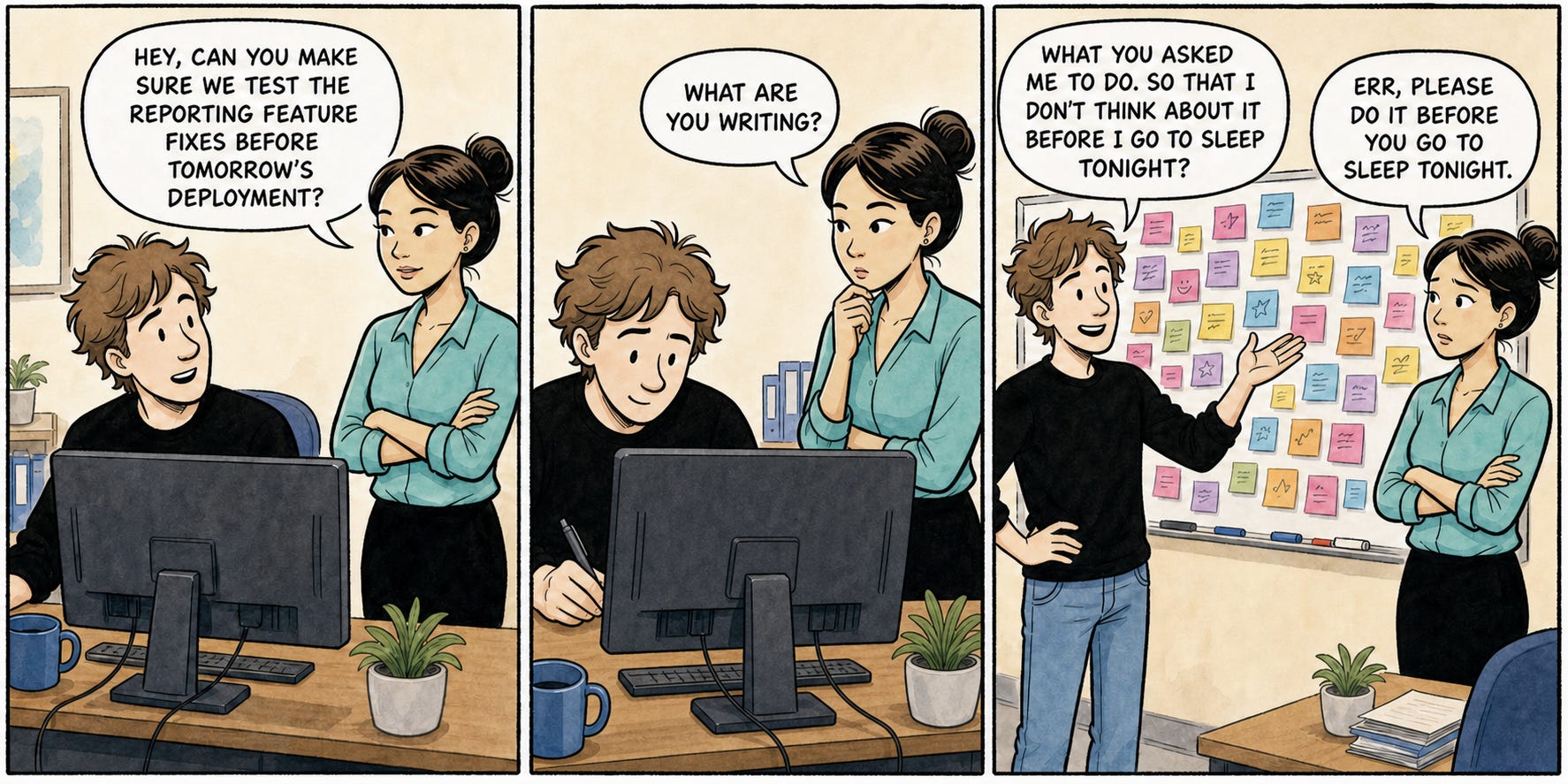
But they found more - finishing the task worked but so did something much smaller, writing a specific plan for when and how the task would get done. Participants who made a concrete plan showed the same drop in intrusive thoughts as participants who actually completed the task.
The brain doesn’t need to work to be completely done but it demands a plan. An open loop with a plan reads as handled, even though nothing has actually happened yet. That’s why the unfinished email lingers at the back of your mind but the meeting you’ve already scheduled to deal with it doesn’t. Same task, same amount of undone work, but completely different mental weight.
Close the loop
The best option is always to finish the thing. Send the email, have the conversation. Nothing beats actual completion for getting it out of your head.
But most days, you can’t finish everything, so the next best move is to close the loop some other way.
Write the plan down. Not the incomplete task at a high level but something specific like scheduling a meeting with a stakeholder to clarify assumptions as the first concrete step.
Journal it. If a conversation is replaying in your head, write out what happened and what you’d want to say or do next. The point isn’t to solve it on the page but to give your brain proof that the loop has a next step. Write down the difficult conversation you plan to have with your colleague and see what happens to your thoughts after. You might not even need to talk to that colleague after.
Say it out loud. Tell a colleague or your partner what’s unresolved and what you’re going to do about it. Speaking the plan externalizes it the same way writing does. And that’s why therapy also helps.
None of this requires the problem to be resolved. It just requires your brain to stop treating it like an emergency with no plan attached. The conversation that keeps replaying, the task sitting half-done - your mind isn’t asking you to fix it tonight.
It’s asking you to tell it what happens next.
Sources:
Consider it done! Plan making can eliminate the cognitive effects of unfulfilled goals
Some excellent advice here as it is something I go through far too often, my biggest problem is 2nd guessing the responses which can be crippling mentally and on so many occasions was a total waste of my energy as what was playing out in my head, was not the reality when I had the actual conversation with others.