The Quiet Collapse
Burnout doesn’t announce itself.
It builds slowly, then arrives all at once. One day you’re grinding through, the next you can’t remember why you started.
It’s not laziness. It’s not weakness. It’s your system telling you the math stopped working.
What’s Actually Happening
Burnout is three things collapsing simultaneously: energy, engagement, and belief in your own effectiveness.
The World Health Organization classifies it as a syndrome from chronic workplace stress that was never dealt with. The clinical definition captures the mechanics, but not the feeling. The feeling is that you used to care, and now you don’t, and you don’t have the energy to care about not caring.
Research points to six root causes:
Overwork - sustained output without recovery
Lack of control - doing work you can’t influence or redirect
Insufficient reward - effort that doesn’t register as valuable
Weak community - no one to absorb the friction with you
Unfairness - effort not matching recognition
Values conflict - your work asks you to be someone you’re not
None of these require a toxic job. They can accumulate inside a good job over time, invisibly.
Why It Gets Worse As You Age
This is the part most people don’t talk about.
Early career, you’re running on novelty and ambition. The dopamine from learning new things covers a lot of structural problems. You’re still building, still proving, still discovering what you’re capable of. The fuel is intrinsic.
By midlife, that fuel shifts. You’ve hit the milestones. You’ve earned the title, the income, the reputation. And instead of satisfaction, many people find a strange flatness.
The achievements don’t land the way you expected.
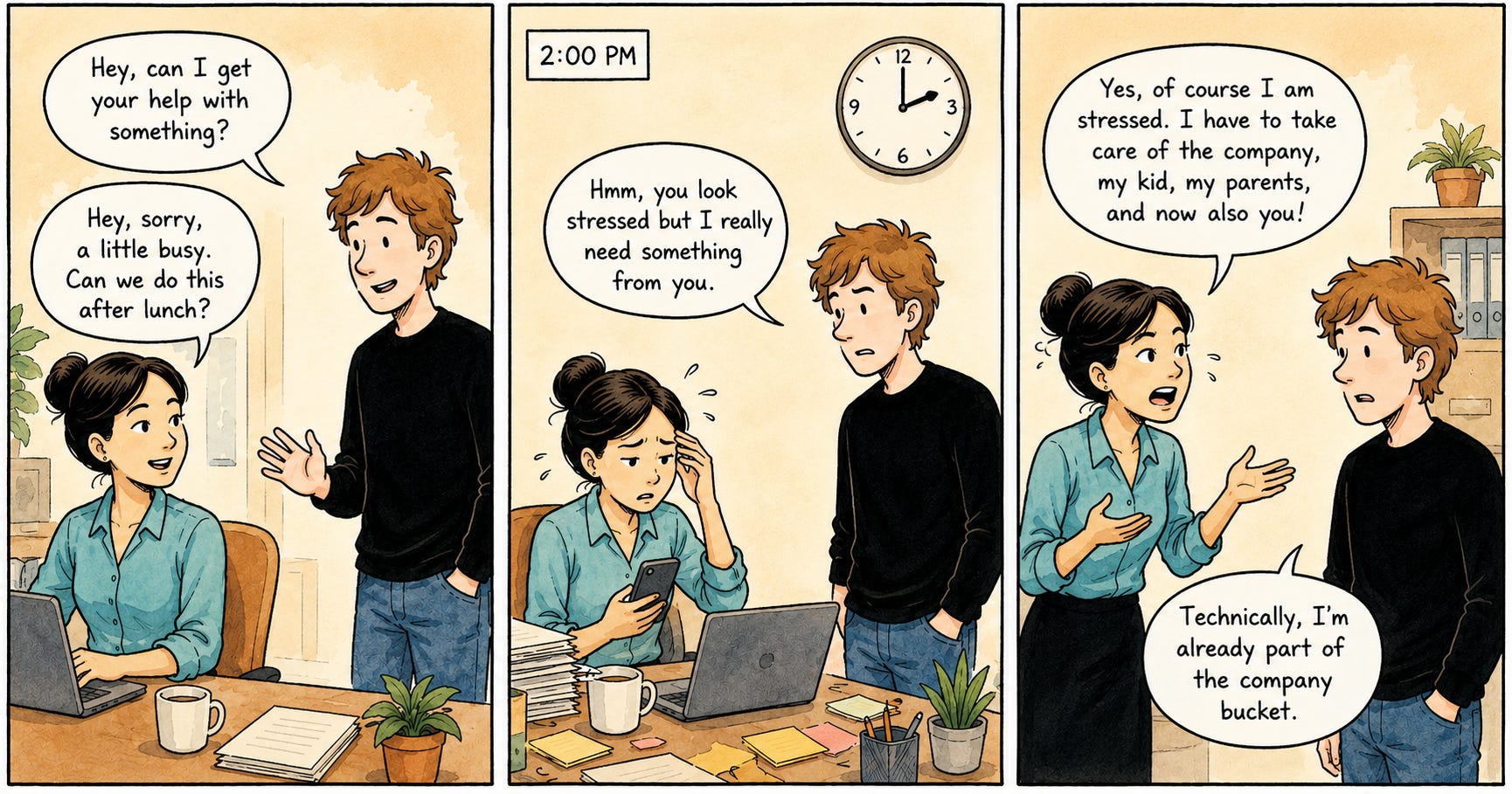
At the same time, the load has compounded. More responsibility. Less tolerance for inefficiency. Probably a family, aging parents, or both. The “sandwich generation” is real: about 47% of adults in their 40s and 50s are simultaneously raising children and caring for aging parents. That’s two full emotional jobs running alongside the work one.
The other factor is identity. Younger workers burn out from overload. Older workers often burn out from misalignment. After 15 or 20 years, your values have evolved. What mattered at 28 doesn’t necessarily matter at 42. But the career you built reflects the old values, and dismantling it feels like admitting something.
The result: you stay in a role that no longer fits, and the friction accumulates until there’s nothing left to give.
Burnout is not a character flaw. It’s a signal.
The question isn’t how to recover faster. It’s what you’re willing to change so it doesn’t return.
Most people don’t answer that question. They rest until they feel okay, then reload the same conditions.
The ones who don’t burn out again are the ones who treat the signal as information, not inconvenience.
What Comes Next
The worst move after burnout is trying to productivity-hack your way out of it. More systems, better morning routines, aggressive recovery plans. These treat the symptom, not the cause.
Real recovery has a sequence.
Step 1: Name it without negotiating with it.
Most high-performers resist the label. They call it stress, a rough quarter, a bad month. Recognition isn’t weakness. It’s the precondition for changing anything. Your prefrontal cortex, the part of the brain that actually solves problems, can’t engage while you’re in denial.
Step 2: Create separation from the stressor.
Not forever. Not necessarily at all. But enough to interrupt the loop. Time off, a reduced load, a hard stop at a specific hour. Your nervous system cannot reset while it’s still receiving the same inputs. This is physiological, not philosophical.
Step 3: Audit the cause, not the symptoms.
Most people treat burnout like a sleep deficit and try to rest their way out. Rest helps, but if you return to the same misalignment, you’ll be back in six months. The real question is: which of the six causes was at work here? Overload? Misalignment? No agency? The answer shapes what needs to change.
Step 4: Rebuild identity separate from output.
Burnout is often tied to the belief that your worth is a function of your productivity. The recovery requires breaking that equation. Not permanently abandoning ambition. But finding proof that you exist and matter outside of what you produce. For builders and operators, this is often the hardest step.
Step 5: Redesign the conditions, not just the habits.
Boundaries, recovery rituals, exercise, sleep. All valid. All insufficient on their own. The deeper work is structural: renegotiating what you take on, who you work with, and whether the role still reflects what you actually want from the next decade.


