

A friend of mine is a Principal Product Manager, coordinating roadmaps across three time zones. She has a four-year-old daughter, and her phone stays face-up on the counter, because a message from Bangalore can land at 6 a.m. and one from Luxembourg can land after bedtime, both expecting an answer before the next standup.
She got a strong review this cycle but she probably couldn’t remember the last time she had dinner without checking her phone.
Her situation isn’t rare. You hit the number, and the number changes. Get the promotion, and the next title looks close enough to touch. Hit the goal, and next quarter’s target is already higher. Nobody moves the goalpost on purpose; it just moves, because that’s what goalposts do once you stop asking who set them.
Wanting more isn’t the problem. The question worth asking is what the wanting is costing you, and whether that cost is one you can pay back.
Some things you can rebuild: a bank account, a title, a client list. Other things don’t come back on the same terms. A five-year-old who wants a bedtime story tonight won’t want the same thing, the same way, in five years, the energy you have today won’t be the same in 10 years.
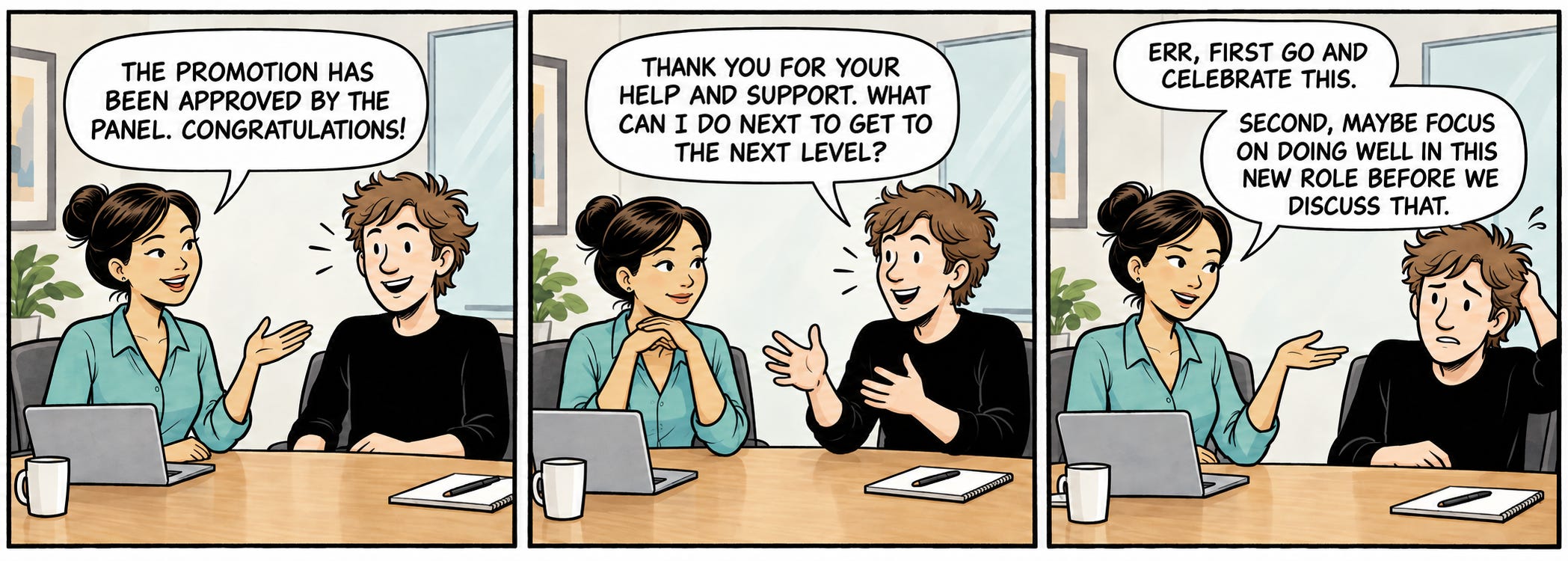
Contentment isn’t complacency
Complacency and contentment split on need versus want, not on fear versus courage.
If your child needs better education and you have a way to get it, sitting still because asking for a raise feels uncomfortable is complacency: the gap is real, and you can close it. If you don’t live in the richest neighborhood, but your street is safe and your kids can walk to a park, the want behind “a better neighborhood” already has its answer, and noticing that is contentment, not settling.
The test isn’t how the decision looks from outside, it’s whether chasing the next thing actually closes a real gap or just moves you further from people who happen to have more. My friend wasn’t sure which one she was doing until she said the phone-checking out loud and realized the real gap, being present for one uninterrupted bedtime a night, was one she could actually close. She’d just never treated it like a gap before.
Part of what makes this hard: everything around you is moving faster right now, and it doesn’t wait for you to feel settled. AI is reshaping what your job looks like in two years. Staying employable and staying ambitious are different projects, though. You can keep learning and stay sharp without needing the next title to feel like yourself. Treat relevance as maintenance you do regardless. Keep ambition as a separate, deliberate choice.
Name the trade you’re actually making
Vague ambition never runs out, because there’s always a next rung. The only way off it is to see clearly what you’re paying to stay on.
Try this before you close the tab. Write down three tradeoffs you’re currently making, specific about what you’re giving up and what you’re actually getting. A few to prime the list:
Did you avoid a vacation to not impact your promotion changes? What happens if you go on the vacation anyway?
Did you check Slack during bath time so a different time zone doesn’t wait until morning? What happens if it waits?
Did you buy cheaper furniture to avoid impacting your savings account balance? What is that number actually for?
Now write your own three. “I worked Saturday because the project needed it” describes the day. The tradeoff underneath it sounds more like: “I worked Saturday instead of taking my daughter to the pool, because right now I want the promotion more than I want that Saturday.”
Read it back and ask one question: if this trade were permanent, would you still make it?
That’s what enough is for.
Not to make you stop wanting things, but to make sure you’re the one choosing what you give up to get them.